Sunday, 17 February 2019

Michael Davitt in Arran in 1888

Michael Davitt visit to Arran in 1888 (Part 1)


The almost permanent distress on the Aran islands during much of the 19th century is a recurring theme of newspaper reports of the time. The islands, like the rest of the country, suffered occasionally from excessively wet seasons, but the shallow soil on the porous limestone rock made long dry spring/summers, an even more feared event.


When fishing was bad, the village of Cill Éinne suffered even more than the rest of the islands as the villagers had very little land. 1879 saw a general crop failure all over Ireland and relief efforts at the time avoided a catastrophe like the Gorta Mór of the 1840s.


When Michael Davitt decided to visit the islands in February 1888, things on the islands had not really recovered and only relief in the years before had avoided deaths from hunger. There had even been a successful battle over rents between the islanders and the police in 1887. We wrote about this before. https://www.aboutaran.com/2016/11/battle-of-chaircir-mhor-aran-islands.html


Davitt himself was well aware of what hunger felt like as his family had been evicted in Mayo, when he was just a boy of four and his family later fled Ireland and settled in Lancashire. When little more than a boy, he went to work in the mills, where, as a teenager, he lost an arm. A generous benefactor had seen to his education and the rest is history.


This article is a reproduction of a harrowing account of Michael Davitt and Fr Michael O’Donohoe visiting a starving family in Cill Éinne and it makes for very disturbing reading. It’s obvious the Michael O’Donohoe showed Davitt one of the very worst cases but it’s shocking nonetheless. Murtagh Farragher was curate at the time and makes a brief appearance.


Before that, the account has some humorous moments, when the 25 year old American journalist, Blakely Hall, London correspondent of The Sun newspaper, gives some background on giving Castle detectives the slip at Galway dock and a rambling story they were treated to by the mainland jarvey on their way to Casla Bay.


Reassuring that the mainland jarveys were as gifted in 1888, at spinning a good yarn about the vineyards of Connemara, as some on the islands are today. The stage Irishman dialogue can be grating after a while but Blakely’s age might explain and even excuse this. We give it to you more or less as it appeared.


Michael Davitt and Fr O’Donahoe would later clash over relief funds. They came to the problem from different angles, with Davitt believing that relief was fine short term but long term, he was a revolutionary, who wanted the whole system overthrown. Davitt regarded the destitution as being the will of the system rather than the will of God. Davitt may also have suspected the priest of downplaying the help that emigrants had sent back.


Interesting that of the three men in Irish history who were most committed to this type of thinking, Davitt, Larkin and Connolly, two spoke with an English accent, Lancashire and Liverpool and the other, a Scottish. 

This account of what Davitt encountered in Cill Éinne is both long and disturbing and some readers will find it very upsetting. Be warned. The very last lines of Blakely Hall’s account will stay with readers for a long time.

He wrote “ The face of the dying woman was livid. I could not look at her and I went out into the night, leaving the wretched family with the priest, for Davitt had followed me out. Presently the priest came out and led the way silently back to the cottage“

            ------------------

     Three Thousand in Want. 

        Michael Davitt's Visit to the
                 Arran Islands
             ------------------------
          The Great leader ideolized by the
                       Starving people.
                    ---------------------------
       Hunger and death in Fisherman's cabin.
                      -------------------------
        Arran Islands, Galway Bay. Feb 10th 1888
                          by Blakely Hall
                   Michael Davitt 1846-1906


Michael Davitt, accompanied by your correspondent, arrived here yesterday after a final and heartless piece of diplomacy directed towards the British detectives.
The misery and destitution on the islands is so great that imperative relief was demanded. A fund was placed in Mr Davitt's hands for the purpose of supplying the people with food. When we left the hotel in Galway early yesterday morning, three detectives followed us to the wharf. 

There was but one sailboat there and we engaged it.
"How far is it to the Arran islands ?”
"Thirty miles” said the boatman with a glance at the clouds.
"It'll take us 'till night to get there with this wind”
"Is there a shorter way?”
"There is”
 "What is it ?”
"Take a car along the shore till you come to Costello bay, and thin sail tin miles across the channel.”
"If we don't take your boat” remarked Mr Davitt, gazing dreamily at a great disturbance at an upper pier, “What will you do ?”
"Faith your honor, I'll sail down the bay and git a mass av fish”
"How Far ?”
About twelve miles
"Could you make it double the distance ?”
"I could sail ahead then and be sure our friends there do not catch you”
The type of men and boat that led the detectives on a wild goose chase.

 The skipper looked ahead, grinned delightedly and calling his men, ran up the mainsail, shook out the jib and moved away.

We were sheltered from view by a pile of bales. The disturbance at the adjoining pier had at last settled down into a bargain and the three detectives set out to sea in a long rowboat manned by four men.

 They evidently thought we were in the cabin of the little sloop and the Irish skipper of that stanch little vessel kept up the delusion to the immense delight of himself and his crew by holding long and exited conversations with nobody in the cabin. The sloop sailed away and after it struggled the rowboat, with the spray dashing over the huddled figures of the detectives in the sternsheets.


Our jaunting car started along the smooth roads an hour later and we saw no more of the chase of the fishing boat that day.
Connemara mail car 1880s
Photo by Major Robert Routledge-Fair

The long drive of 24 miles was broken by the crowds that cheered Mr Davitt whenever we passed through villages.
Finally we came to the end of civil action and stopped for a bite before crossing a bleak moor to the edge of Costello bay. It had grown late and very cold. The driver alone was impervious to the weather.

"Dis here place is famous Mr Davitt” he said, indicating the road with a sweep of his whip, “f'r bein de scene av a wish bein gratified. A young man wuz wa'kin along here about four years agho, all alone wid his pig, whin a fairy sez t' 'im,
                                       "Phat'll y' 'ave, young man ?”
"Faith, I'll hev a coompanion av me own age t' talk an sing wid”
                   "Shall I change yer pig into a young man ?”
                                                                        "Aye”
So sayin, the fairy up an' done it an' the pair av thim walked along happy and chatty till dey cooms to a vine where tousands of grapes wuz growin. Th' first young man ate his full an'stopped as a gintieman should.
Th' sickond, which wuz wance a pig, ate like a pig an' couldn't stop. Faith he grovelled.
Thin th' first young man yelt, Wance a pig, allus a pig, an th' other young man was changed back into a pig again”
                "Do you believe all that, I asked.?"
Indade I do. Why should I not, whin me own mudder seed it wid her own eyes”
It was 4 o'Clock before we started for the biggest of the
                     THREE ARRAN ISLANDS

A traditional Connemara sailing boat making a more recent crossing from Connemara to Arran

We found a fishing boat of about 40 tons burden and chartered her to take us over. The man demanded the exorbitant sum of one shilling for carrying us 10 miles.

"An Oi'll be glad t'git it” he said, “fur our luk's bin bad. We fished fer two days an' only caught two fish. We traded wan ay th' fish fur a busn'l av pertaties an afther carryin th' spuds tree miles th' mate slipped an spilt th hull lot overboard.”

This tale was told with a horror-struck face as we talked in the teeth of a howling wind that sent the spray from stem to stern. It was rough sailing and we were drenched half an hour after the start.

"Fer weeks at a time” the skipper said, no boat kin git to or from the islands so rough is the water, an thin th' poor divils have t' go widout letters an' news an' sometimes food. Manny a boat's bin wrecked on this bay”
I thought of the detectives in the rowboat and wondered where they were.
Straw Island, Oileán an Tuí Lighthouse.


It was dark when we swung past a towering lighthouse and brought up at a small pier. But, despite the gloom the boat had been seen and the pier was crowded by a mothly group of half-clad men and women who recognised Mr Davitt in the glare of the lantern and divining that he had come on a mission of mercy and benevolence, they raised a cheer that echoed back and forth between the stony hills half a dozen times.


 Some of the people ran ahead to tell the priest the news and others tramped silently after us. As we ascended the hill the door of a small cottage was thrown open and the parish priest, Father O'Donoghue, and his curate Father Farragher came out. They were on a bluff and as they hurried down the rocks to meet us the gale blew their robes wildly to and fro.

The children, dancing and screeching wildly around the two priests, looked like demons in the half light. The people broke into wild shouts. The arrival of Mr Davitt meant food and many of them were literally starving.
Priests house, Arran after the erection of the cross in      memory of Fr O'Donahoe in the 1890s  (N.L.I)
                                      
"It's the most mortifying thing in the world to me to be obliged to appeal to charity again this year” said Father O'Donoghue, after we had been warmed and fed “but what can I do. My people are literally starving to death. The potato crop has failed and there is no market for their kelp. They have not the money for buying the elaborate and expensive vessels and tackle necessary to fish successfully in these stormy seas and the result is that our 3000 people are in absolute want. Unless they get some seed potatoes and immediate relief from hunger, the death rate will go on increasing appallingly.”
Is the soil so bad ?”

"There is no soil to speak of. For centuries the people have dug the sand and mud out of the sea and carried it on their backs up on the hills of rock. They have spread it carefully and laboriously over the surface of the rocks and when the fields thus made reached a depth of six or 10 inches they planted potatoes and so got their food. When a dry year comes it is good for the potato crop on the mainland but death to the potato crop here. For the soil is so light that the sun burns the potatoes away.

"Is there no market for kelp” asked Mr Davitt
"No one will buy it. Only two firms purchase it now and as they employ the same buyer the people are swindled. Kelp” the priest said, turning to me, “is seaweed,". 

"The people wade into the water above their waists and gather a peculiar type of weed of a deep red colour. It is very difficult to get it at times, as it clings to the rocks in dangerous places. After it is brought ashore, it is thatched with potato stalks and dried in the sun for weeks.”

"In September it is burned. From the ashes chemists get iodine. Can you imagine the amount of work that is required to get a ton of this stuff. When it is ready it is transported to Kilkerran. Once the people received £9 a ton for it. Now they are fortunate if they get £3 a ton for it. Theagent pretends that he has a chemical analysis for testing the kelp. Sometimes he he refuses it altogether and again he will pay 10 shilling a ton. Of course he can do exactly as he wants to as he has no competitors.

 The people must take what he offers or throw their kelp into the sea. Last year two brothers named Flaherty divided a pile of kelp into two loads. One brother recieved £3 for his share, the other was told that his kelp was worthless.
Not a farthing would the agent give for it. Flaherty sailed away and sent the same kelp back by his uncle O'Brien the next day. The agent paid £4 for it at once.

It is such dealing as this that upsets the people and ruins their ambition. Their lot is very hard and yet they are most faithful and good. Think of what an advanced state of morality there is here when I tell you that there has not been an illegitimate birth among the 3000 people on these islands in 40 years".

                      " Is there no emigration ?”
There was worse luck” said the priest with a doleful shake of his head. “America took the flower of the people. A fund was raised and the young men all sailed away, leaving only the children and the old people on the islands. The boys are doing well across the water, because the people of Arran are naturally frugal and industrious, but they have forgotten the old folks at home. Many appeals have been made to them, but in vain. When they first arrive in the States they send a pound and a photograph, but that is all. Once in a while they recommend the workhouse to their starving friends.”
                      "Is there a workhouse here ?”
"No indeed. The nearest one is 32 miles away. If one of my people goes in they might as well all go in, for the degrees of poverty are very slight. We are all taxed to support the workhouse but I'm proud to say there is not a man or woman of Arran under the roof. I'll show you how the poor laws work for the Irish poor. A fisherman here- a good steady hardworking man- found things going against him. Toil as he would he could not make both ends meet. He worked night and day. Once I remember he caught 120 fish. He journeyed to Galway with them and sold the lot of four shillings. Then he travelled back with the money, having done 60 miles. In spite of his struggles his wife died of privation and the lack of necessaries of life. He was left with four little children on his hands, besides his invalid sister. A man can struggle to the limit-no more.

I could not help him because my money is long since gone and there are hundreds of pressing cases. The fisherman was desperate. His children cried all day for food. Finally, one of them fell ill and this decided him. He took them all to the workhouse. When he got there at last, they refused to take the children in, despite their pitiful condition unless the father would go in with them and work for their support. Of course he couldn't do this, for his invalid sister would have died without his care. He begged to have the youngest child taken in even if the others were not. All of no avail. He was turned away without a copper to help him on his long journey back.

Here he is at home again, willing to work himself to the bone and never complaining of his responsibilities, but his lot is hard enough. The youngest child died not long since. He sent for me and I was going to his cabin tonight.
                        "Anything of special importance ?”
"The sister's very low” said the priest, rising half apologetically.
         "Shall we go with you ?” asked Mr Davitt.
"It will be a long walk and a cold one”said Fr O'Donoghue, “but if you wish to sound for yourself the depths of human misery, come”

It was after 10 o'clock and the wind was whistling furiously around the little one-story cabin as we started out. The stillness of death reigned without but for the noise of the wind and I was startled by finding myself face to face with a crowd of several hundred people who had gathered silently in front of the cabin and stood there in there in the fierce cold clad only in rags and waiting patiently to get a look at the Irish leader.

    Aloysius O'Kelly sketch from 1886

Father O'Donoghue was as much surprised as I was to see the assembly. They cheered when Mr Davitt followed us out of the house. The priest stepped forward quickly and moving to the centre of the big crowd, held up his hands. Hats were whisked off on all sides and the men and women pressed forward like children to listen. The moon lighted the scene.

Then Father O'Donoghue talked to them in a gentle and insistant way, as a mother reprimands a sickly child. It was wonderfully impressive. The priests low, deep-toned voice seemed enchantment to their ears.
"You should go to your homes for the wind is sharp without and shelter is needed to the thinly clad. Keep well within doors and prepare for the relief that is to come. Not long will you have to suffer for a good friend has come among you to see if you are honest and willing to toil. If you are, work will be provided for you and from work comes food. No money will be given away for that makes paupers of you and I know you would rather work than beg, no matter how dire the need. Mr Davitt is worn with long journey tonight, but tomorrow he will speak to you all. Go now, go to your cabins and to bed.”

Without a word they hurried obediently away. We started briskly down the path after the priest who strode sturdily along a rocky road that ran by the edge of the bay. The mountain of rocks rose on one side, the sea stretched out on the other. 

We marched thus in single file for half an hour, and then approaching a small village, the priest led the way to one of the houses- that occupied by the fisherman whose story he had told us before we started out. He lighted a bit of candle which he had brought along and held it aloft after we had bent almost double and passed through the low doorway.
 
             Cill Éinne in the 1890s
The cabin was small. The earth formed the floor. Two pieces of peat burned in the fireplace. The smoke hung about the ceiling of the room.
A little bench was placed in the fireplace, almost atop of the burning turf and on it sat three wretched little figures with naked legs, skinny arms and drawn faces.

The oldest of the children was about 8 years- the youngest 4. Two of them whimpered continually, but the youngest sat with his elbows on his gaunt knees and his chin sunk in his little hands, staring with fixed and stony misery at the opposite wall. Nothing could avert his gaze of absolute despair. 

I dropped on one knee and spoke to the children; the two who were crying turned their red-lidded eyes towards me but the boy stared on unheeding. I never saw such an awful figure of childish agony. The face was thin and the cheeks so sunken that the eyes seemed twice their natural size. The little things all trimbled from the effects of the cold.

Where do they sleep” I asked
Where they are sur” said the fisherman, quietly. “Its too cold in my bed there” he pointed to a mound of moss and dried grass in the corner near the door. It was about three feet square. “Then aunt's too sick fur t' take them in her bed” the man added.
Is she bad tonight ?” asked the priest
Faith she is father, I bin for two nights tryin' t' keep her warm this way”

He was on his knees in front of the little fire holding a square bit of carpet about as big as a napkin, so as to warm it thoroughly. He had an honest and prepossessing face but the lines of suffering were drawn clear and sharp. He rose as he spoke and stepped across the little hut to a kind of doorway cut in the wall. 

He motioned us to follow.
You kin look at the poor girl” he said “Faith she'll not know it, fur her strength has so gone that she no longer opens her eyes.

Within the stone doorway was an alcove abot the size of a man's coffin and perhaps four feet high. Stretched out in this living tomb was his dying sister, lying on her back on the earth with some moss under her head. She was about thirty years old,worn to a shadow and dying of consumption. 

As the light fell on her, it startled us. She wore no chemise or night dress but she was partly covered by bags and pieces of carpet. Her breast, shoulders and arms were bare and wasted away beyond belief. The bit of carpet that her brother had warmed at the fire was pressed by him over her breast and held there tenderly until it was time to warm it again.
“It gives her relief” he said softly “poor crayture, she breathes easier when I put it on her”

The face of the dying woman was livid. I could not look at her and I went out into the night, leaving the wretched family with the priest, for Davitt had followed me out. Presently the priest came out and led the way silently back to the cottage.

(Part two is less harrowing and can be read HERE )

     (Feb 1888 by American journalist Blakely Hall) 


Wednesday, 30 May 2018

A Blast from the Past.

When Rodger Dirrane/Derrane bombed the priest's house in 1908.

Priest's house is the flat roofed building on the right.
Slated building on the left is now site of the R.N.L.I. station.


The bombing of the Parish Priest's house in Cill Rónáin in 1908, has been, until recent years, a subject that many Islanders were reluctant to talk too much about. In deference to the Church and to the descendants of some of those involved, this is very understandable. However, while we may be inclined to take undeserved credit for heroic actions of our ancestors, we certainly should not be expected to take blame for those less noble deeds.

The background to the incident is complicated and those who don't want to have a long read, should stop now. 

The two main characters involved were a very forward thinking and industrious priest, Murtagh Farragher and a local bailiff, carpenter, relieving officer, shop keeper and publican, Roger Dirrane.

Being part of the Archdiocese of Tuam, the Aran Islands have a long history of Mayo priests and Fr. Farragher hailed from Hollymount in South Mayo. He had served as curate on the Island from 1887 until 1891. He returned as Parish Priest in 1897 and his influence on all three islands, until leaving for Athenry in 1920, was huge.
Rev Murtagh Farragher as a young man.
 Photo kindly supplied by Murtagh's grand nephew and namesake.


A large part of the old Irish Landlord class, who had ruled for centuries, were for the most part, bankrupted by the great potato famine of the 1840s. The voting acts in Westminster had resulted in the electorate in Ireland going from 224K to 738K and this, along with the secret ballot, resulted in a shift of power from the Landlord class to the Catholic Hierarchy.

O.S map of 19th century Killeany showing the village clustered around Arkin Castle and the Lodge to the South. Fr Farragher was instrumental in having new cottages built here in 1914.


The 1903 land act and various other land acts had resulted in the British Government buying out many estates and distributing the land to the tenants who had worked these lands from ancient times.
The decision to buy out the old Digby estate on the three Aran Islands would result in tensions over who would get which piece of property and was the main cause of the row between Rodger Dirrane and Murtagh Farragher. The Digby estate was finally sold for £14,000 to the Congested Districts board in 1914 but before this, Fr.Farragher was believed to have much influence on how it would be distributed.


Roger Dirrane/Derrane was a reasonably wealthy man and had been employed as both a relieving officer by the Galway Board of Guardians and as a bailiff by Henry A Robinson of Roundstone, the Digby estate agent. 

He had control of much of the Hill Farm in Cill Éinne as well as the large hunting lodge, high on the hill. He also had a pub in Cill Éinne as well as a shop and various other properties in Cill Rónáin.

Roger’s job as bailiff was a dangerous one and it seems he carried a revolver. In 1898 he was in court for threatening to shoot Colman Joyce in Iarairne. The case was dismissed. 

His predecessor as bailiff, Bart Hernon had been shot at twice in the 1880s with the second incident leading to the wrongful imprisonment of Cill Rónáin man, Bryan Kilmartin


Killeany Lodge about which Fr Farragher and Roger Dirrane disagreed.

It would appear that Roger appealed to the Parish priest to let him hold on to the hill farm and the Lodge and it seems that Murtagh was determined that the land be distributed to the landless local people, in the fishing village of Cill Éinne. 

Roger had even visited the Archbishop in Tuam to protest against his perceived harsh treatment but got no satisfaction.

The Archbishop would later claim that he and Fr Farragher wished to use the Lodge as an Irish college. The property would eventually end up in the hands of another publican, the late Katie Joe Mac of Cill Rónáin.
Teampall Bheánáin, high above Cill Éinne.
The old Hunting Lodge to the left
.

Killeany Lodge is said to have been built by the aristocratic Fitzpatricks before passing into the hands of Martin O'Malley who, like all the O'Malleys, had a fair bit of smuggling DNA in his blood.

 In 1908, the O'Flaherty/Johnston family of Cill Muirbhigh had control of its leasing but it was owned by the Digby estate at the time of the dispute. Roger had the job of collecting the very high rents which the writer Tim Robinson speculates was not done with any great vigor, in case it might upset the customers in his pub.

Roger would also have known that the Landlord days of old were soon to disappear under the new land acts and it was hoped that arrears might be reduced or even wiped out.


Roger had inherited some of his property when he married the daughter of the previous bailiff, Bart Hernon. Some readers may remember Bart for the role he played in the wrongful conviction  of Bryan Kilmartin in 1882.
   
Interestingly, Roger Dirrane married twice and so had two Fathers-in-Law. His second, Bryan Kilmartin, had been wrongly convicted in 1882 for trying to murder the first, Bart Hernon.


After the death of his first wife, Nora Hernon, whom he had married in 1893, Rodger had married Agnes Kilmartin in 1896, the nineteen year old daughter of Bryan Kilmartin  and it was this connection that would see Bryan's son Martin (Matty) Kilmartin caught up in the bomb plot.

Here is a photo of the house Roger Dirrane's daughter Katie, lived in until the 1970s.
We would appreciate any help in identifying the people featured. We though it might be Roger Dirrane and his wife Agnes Kilmartin, with perhaps Katie standing between them, but this now seems unlikely.The house is now a ruin but was located next to the old Sean Chéibh restaurant, now home to Quill's Woolen Market.  Photo by Jane Shackleton, taken in 1906
.


There was much bad feeling on the island as the priest had a very authoritarian approach and Roger had the triple fault of being highly intelligent, avaricious and fiercely stubborn. Things could only get worse. 

Fr Farragher was equally stubborn and had clashed with a number of bodies. Although a fervent supporter of the Irish language and a founding member of the Arran branch of the Gaelic League in 1898, he had supported his curate Fr. Charles White in 1902, when he was attacked by some language enthusiasts over sermons in English. Fr White had arrived on Aran from Achill in 1900.

Murtagh dug his heels in and in August 1902 even went so far as to deny a visiting priest, Fr Michael O'Hickey, who he believed was critical of his curate, the right to say mass in his parish.

 In truth, O'Hickey was more critical of the Archbishop, who had sent a man with very little or no Irish, to minister in an Irish speaking parish.

 Michael O'Hickey was Vice President of the Gaelic League and Professor of Irish at Maynooth College. After being forced by the hierarchy to resign his position in the Gaelic League, he would eventually be dismissed in 1909 from his job in Maynooth, after criticising the Bishops stance on the language. 

Fr White had claimed that everybody understood his sermons in English but later admitted that he had said this in order to annoy the people who were criticising him.

Murtagh showed his stubborn irrational streak because his own credentials with regard to the language were impeccable and he had introduced bilingualism in the schools which had previously been all English. 

Interestingly, Murtagh and his Protestant counterpart, the Rev William Kilbride, were very active in their support for the Irish language and Irish culture in general. Indeed, William Kilbride is credited with having one of the first Irish inscriptions on an Island headstone. This was for his wife Máire, who died in 1891.
Fr Michael O'Hickey.
 A man whose defense of the language would cause him much trouble.
He was denied the right to say mass on Inis Meáin  by Murtagh Farragher


Fr Farragher also forbade the National School teachers of the three islands from attending a great Feis in Galway in 1902, organised by the Gaelic League. This, even though the teachers were on holidays at the time. Is it any wonder that Fr Farragher and the local teacher, David O'Callaghan, had clashed ?


Roger had inherited the job of bailiff from his father-in-law Bart Hernon and had been the bailiff on duty during the infamous island evictions of 1894 and this would have made him a less than popular figure on the island. Over 120 people and 17 families had been evicted and the event must have played a part in Fr. Farragher's bad feeling towards Roger. Bailiffs during those times were hated even more than Landlords and almost as much as land agents. Clashes between the local bailiff and the local priest were very common in Ireland. 
The 1894 evictions in Arran which were aired in the Parliament.
The bailiff on duty was Roger Dirrane and what was most unusual was that he was also the Relieving Officer.

Fr Farragher was probably bitter about the death of Fr. McPhilpin during the 1894 evictions, as he travelled to meet Chief Secretary for Ireland, John Morley and get some relief for his parishioners. Peter McPhilpin was very radical and had clashed with authority, both civil and clerical, more than once during his years as a priest. 

On McPhilpin's death and before the appointment of his successor Fr. Colgan, his newly ordained curate, Fr Michael McDonald, had taken up the challenge and acquitted himself well when he addressed the Board of Guardians in Galway. This body had the responsibility for relieving distress on the three islands and often played down the severity of the situation, as the ratepayers who elected them would have to foot the relief bill.
Morbid illustration of the Arran evictions of 1894.
The distress was raised in the House of Commons in London. (N.L.I.
)


A local bailiff had the job of identifying stock and figuring out who might be pressured into paying the rent. He would know also which Islanders had children overseas and would respond to the threat of their parents and siblings being evicted. 

The charge had been made more than once by bailiffs, that priests were exaggerating the distress in order to profit from relief funds. In Aran as elsewhere, the main purpose of putting a family out on the road, was not just vindictiveness but was to send a message to others who hadn't paid their rent and to relations who might help.

On the night of June 1st 1908 Fr Farragher's sister Theresa and a servant woman May Flaherty, retired at about 11P.M. Shortly after midnight they were awakened by an all-mighty bang and they thought the house had been struck by lightening. Shortly afterwards they heard a second crash and on inspecting the dining room found it to be severely damaged.

The state of Fr. Farragher's dining room on the morning of June 2nd 1908 (Photo Galway Co Library)

Most of the plaster from the ceiling can be seen scattered around.
Photo Galway County Library


The two women were terrified and were afraid to venture out until the sun had risen next morning. This act against two defenseless women would go badly against the perpetrators, as most islanders felt that whatever about putting the fear of God into the priest, terrifying two innocent women was very wrong. It's possible that the bombers were unaware of how much damage their bomb would cause, as it's unlikely they could have tested their invention out, prior to the attack on the house.

Directly behind the trawler is the shed where Roger is believed to have made his bomb.
 Photo by Raoul Lemercier 1970s

  The celebrated writer Tim Robinson, in his book Stones of Aran Labyrinth, amusingly uses the words 'Unfortunatly Farragher was away' and its hardly credible that the bombers didn't know this and that the two women were at home. The dividing wall of the room directly above the blast, was split in two. While some have always held that the damage was not substantial, the photos indicate that there was a fair bit of power in the blast.

The curate Fr Owens and local men Coley Costello and Pat Hernon, called to the house in the morning and discovered immediately that some sort of bomb had been detonated. After a thorough investigation, first by Seargent Parkinson of the R.I.C. and later by District Inspector Mercer, Roger Dirrane and his teenage brother-in-law Matty Kilmartin were arrested and on June 10th 1908, conveyed on the S.S. Duras to Galway.


S.S. Duras which conveyed the prisoners Roger Dirrane and Martin Kilmartin to Galway (Photo  N.L.I.)

The bombing of a priest's house had made international news and there was a massive amount of outrage at this almost sacrilegious act. For this reason, all police leave in Galway was cancelled and a large force was on duty at Galway dock in order that a mob of over two thousand outraged citizens, didn't take the law into their own hands. 

Newspaper report on the Arran bombing of the priest's house in June 1908


The trial opened in Galway on July 1st 1908 and after extensive and very convincing evidence by witnesses and forensic experts, both men were convicted by the jury, after less than an hour of deliberations. Unlike the case of Bryan Kilmartin in 1882, there was little doubt among Islanders of their guilt.


The Archbishop of Tuam, Dr. John Healy was among the witnesses.

Rev John Healy, who gave evidence in court.

In the course of his evidence Fr. Farragher had to admit too much bad feeling towards him for over ten years and that he had once assaulted a man he had a disagreement with. Fr Farragher had favoured trying to get a settlement on a cess that had been due since the 1880s and which was the cause of a famous battle in 1887. We wrote about this in a previous article.
http://www.aboutaran.com/2016/11/battle-of-chaircir-mhor-aran-islands.html
  Others resisted paying anything.

One of the most damning accusations against Roger was that, as part of his disagreement with the priest, he had stopped going to mass since Christmas 1906. Fr Farragher had also reported the local rate collector to the authorities for some perceived wrongdoing and he had been dismissed from his post.

Fr Farragher also had to admit to hitting a woman with a stick after he had lent her money to go to America and she hadn't paid him back. He added that she never did pay him his money and this evoked great laughter in court.

The curate Fr Owens gave evidence of seeing Roger and Matty heading towards the Old Pier on the evening of the 1st of June.  He had been out in his garden at the time. Ingredients for making a bomb had been found in Roger's shed on the Old Pier.
Fr Owens' cottage behind the cross. To the left in the distance is Rogers vacant house where evidence was also gathered.


At the time of the bombing, the dispute with teacher David O'Callaghan had been going on for some time and the curate, Fr Owens, had assumed management of Fearann an Choirce (Oatquarter) school. This dispute would later become world famous after the eviction of David O'Callaghan in 1914 by Fr Farragher. It also provided the inspiration for the writer Liam O'Flaherty's book 'Skerrett'. In the course of that very bitter dispute, Murtagh had refused to hear the confession of David O'Callaghan, or to give a reference to his son Michael when he was entering teacher training college. The bombing would see an escalation in this dispute.

That story is for another day but it's important, that having read O'Flaherty's book 'Skerrett', readers understand that while the book is loosely based on the row between Farragher and O'Callaghan, at the end of the day, it is a work of fiction.
 The character 'Griffin' was inspired, it’s believed, by Roger Dirrane, a cousin of O'Flaherty's father Michael. Skerrett has been endlessly studied for hidden meanings etc but in many ways it was also a way for Liam O'Flaherty to get even with his enemies.
Limerick teacher David O'Callaghan in 1906 with his pupils in  Fearann an Choirce (Oatquarter). Photo Jane Shackleton)


Roger was adjudged to be the ringleader in the bombing and was sentenced to three years in prison.  On the recommendation of the jury, it was decided that Martin, who placed the bomb, was under undue influence from his much older brother-in-law and was sentenced to just six months. Justice Kenny warned Roger that he had a mind to give him fourteen years, so dastardly was the crime. Roger would serve his sentence in Maryborough (Portlaoise) prison in the midlands and was released in September 1910.


They say that a man who has done the crime and done the time, should be allowed to start again but this was not to be the case with Roger Dirrane. In a fit of spiteful rage, Fr. Farragher denounced the culprits and their relations from the altar and instructed his flock to boycott both families and any relations who continued to speak with them. 

This would cause a bitter split on the Island as natural justice, family loyalty and a stubborn streak resulted in many defying the priest and ignoring his orders. Because the bomb had been placed in a saucepan, this nickname would persist for at least a generation and even today some Islanders wear it as a badge of honour.

Murtagh Farragher had started a branch of the United Irish League which was a political grouping that arose in 1898 after the fall of Parnell and before the reunification of the old Irish Party. One of it's great aims was land reform and the redistribution of land. The priest was accused of using this political organisation to enforce his boycott and persecute all who opposed him.

The boycott would be used in the House of Commons to highlight how the Catholic clergy used their power to crush all before them and it's no coincidence that the man who raised it, Charles Craig, MP for Antrim, was a Unionist. Charles was a brother of Northern Ireland's first Prime Minister, James Craig.
James Craig. First P.M. of Northern Ireland. He and his brother Charles would use the Arran boycott as an example of "Rome Rule" being the outcome if "Home Rule" were conceded. Raised the issue in the House of Commons.


The behavior of Murtagh Farragher seemed to give  credence to the great Unionist fear that "Home Rule is Rome Rule". That Irish Catholic Home Rule MPs defended Murtagh, was put down to how the Catholic Church had assumed so much power in Ireland. Any hope Murtagh had of being the next Archbishop, must have been severely dented by the Arran controversies.

  It should be noted that during his time on the Island, Fr. Farragher was responsible for the building of the magnificent Church of St. Bridget in Cill Rónáin, which opened in September 1905. 
Corner stone laid in July 1903 by Archbishop John Healy.


Church of St. Bridget and St Oliver Plunkett in Cill Rónáin. Built under the guidance of Murtagh Farragher.
Corner stone laid by Archbishop Healy on Sunday July 26th 1903. Estimated cost was £1,200.


The original parish church in Eochaill. Built in 1833, not long after Catholic Emancipation and still in use today.  A lovely church with memories of times past ingrained all around. Well worth a visit.


A Boycott is a cruel and crude instrument of revenge and the innocent suffer as much, if not more, than those it is aimed against. While the bombing left some physical damage, the boycott would leave vastly more damage in its wake. It's worth noting that Fr Farragher was able to entertain to lunch, the visiting Bishop Higgins of Ballarat, Australia, just a few weeks after the bombing.

Back in the 70s we mentioned the bombing to an old woman who would have been a girl of about twelve when the bomb went off. She remembered the incident well and said she had spent her life feeling shame about the boycott and wondering how she and her mother had gone along with the priest's instructions. All contact with the families of those, who the priest adjudged to be his enemies, was frowned on. Interestingly, she said that her father, who was a fisherman from Arklow, had ignored the boycott and the priest was afraid to confront him. 

No matter how big or tiny a boat, a skipper then (or indeed now), was his own man and was not used to being told what to do. The majesty and raw power of the ocean has a way of undermining the importance of mere mortals like a priest, the Pope or indeed the King of England. 

This Arklow man had come with his boat in the early 1890s as part of a Government subsidised effort to introduce new fishing methods to the islands. When most of his fellow skippers went home after a few seasons, he had fallen in love with an Aran girl and settled on the island. 

The old lady had also confided, with undisguised pride, "Michael, my father came to this island to teach them how to fish, but I can't say that around here". Kilronan was very much an English speaking village at this time and this old lady, born and raised there, claimed to have almost no Irish.
Thatched cottage where the old woman who remembered the bomb, lived in the 1970s


This old lady and her mother had finally abandoned the boycott after a very petty incident. Benediction was on and a little girl of about nine had gone to the shop to buy candles. With nobody about, the shopkeeper broke the boycott and sold her a few candles.
However, the little girl had been spotted and a grown man had reported the shopkeeper to the priest. This incident she said, opened their eyes to the injustice of the boycott and they abandoned it.

Roger's pub was located just a few yards up a little road that runs from the top left corner of this photo towards Killeany Lodge. (Photo by Jane Shackleton. Thanks to Collins Press)


Another example of Fr Farragher's pettiness involved a National school teacher in Cill Éinne, a sister of the O'Flaherty brothers, Tom and Liam, who was out cycling near the Eastern end of the island. As the day was very warm, she and a friend stopped at Roger's, her father's cousin's pub, for a mineral to quench their thirst. When the priest heard about this he immediately transferred the woman to a school on one of the smaller islands. The teacher resigned her position and headed off to America. Is it any wonder Liam O'Flaherty would portray Murtagh in an unfavorable light, when he came to write Skerrett ?

This also highlights how the teachers union, the I.N.T.O. became one of the toughest unions in the country. While most unions had to battle with one master, this union had to battle with two, the Board of Education, who paid them and the Church who employed them.


The thatched house of the curate, Fr. Owens and the Celtic cross erected in memory of Fr. Michael O'Donohue (Photo N.L.I)
One amusing anecdote from the boycott concerns the burying of a cow in Cill Éinne. In those days and for many years after, it was customary for offerings of money, to be made at every funeral. The more important the deceased, the greater the 'Altóir'' (Altar) which was the term used. People would often remark as to the fine 'Altóir' a dead islander might have generated. This money went to the priest. 

Roger's cow died and a father and son in Cill Éinne gave him a hand to bury the animal. When meeting the lad some days afterwards, Fr. Farragher berated him for helping Roger. The young lad's father happened along and became angry at the priest. His comically, cutting remark has lasted down through more than a hundred years of telling and retelling. Speaking in Irish he told Murtagh, " Agus bheach tú féin ann dá mbeadh altóir ann" (And you would have been there yourself, if there had been an Altar).

Kilronan village in 1906.


This photo is taken from Jane W. Shackleton's Ireland compiled by Christiaan Corlett.
 It is reproduced by kind permission of The Collins Press.


Another amusing story told was that Roger met the priest one day on An Chaircir Mhór.  The priest said in Irish to Roger, " Only for I don't like to, I'd put horns on you", for in those days many people believed that priests had "The Power". Roger replied ,"And if you did, I'd puck you in the arse with them".

 Fr Farragher and Roger Dirrane were in many ways alike and perhaps the Island was only big enough for one of them.
Cill Muirbhigh beach, where a fishing Co Op thrived for a few years during and after the Great War. (Photo N.L.I.)

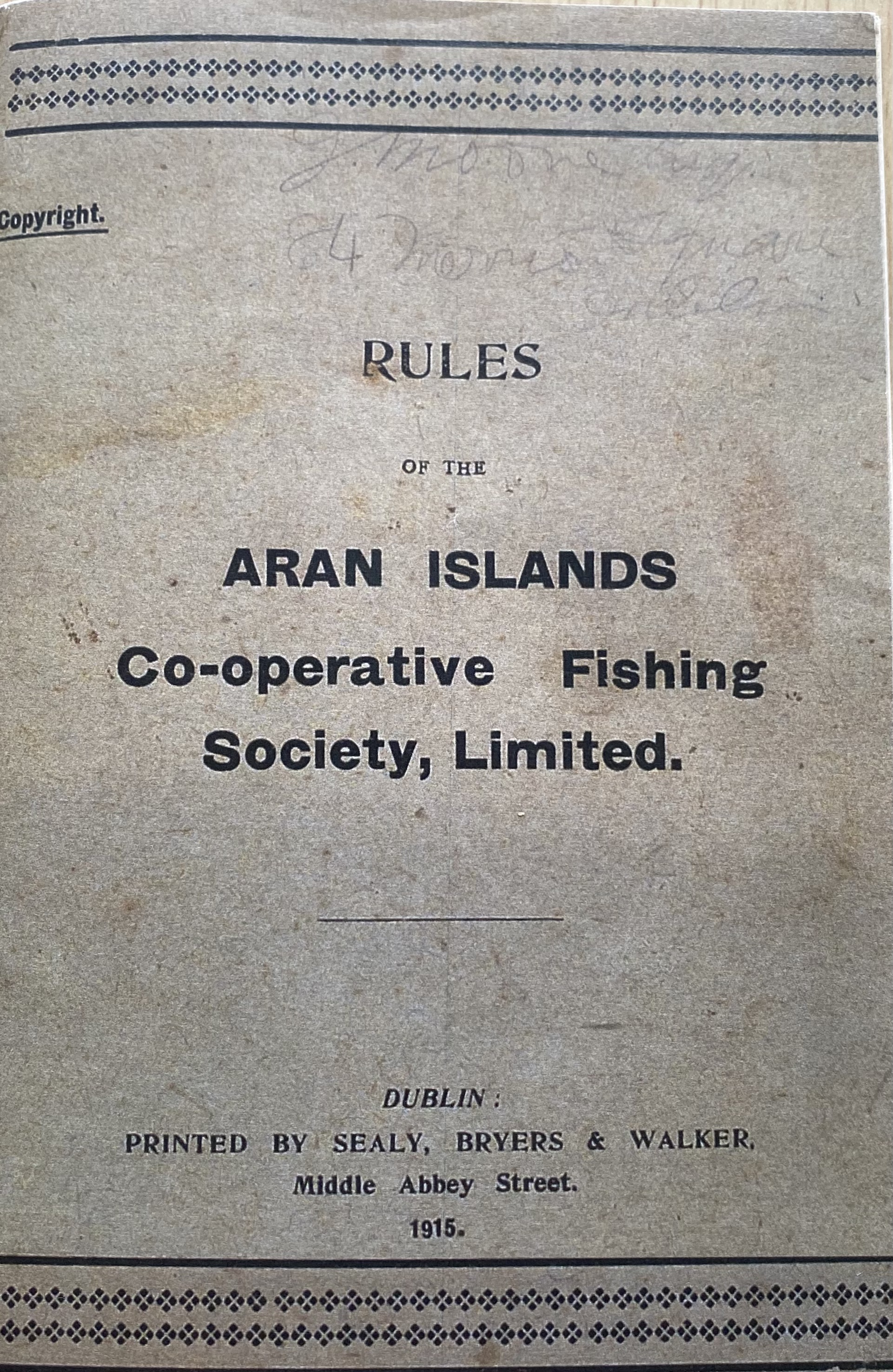
In 1915, Murtagh Farragher also played a leading role in the development of The Aran Fisheries Co Op society in Cill Muirbhigh, which boomed for some years before eventually going out of business in 1922.
(Buíochas le John Bhaba Jack Ó Chonghaile)


 It was Ireland's first fishing Co-Op. The tensions from the boycott had caused trouble in the co-op and didn't help with its survival. Murtagh had found a very lucrative American market for cured fish.  The fish buyers in Galway were not too happy though. .

  Fr Farragher had also been instrumental in setting up in 1898, an Agricultural bank to help small business ventures. This bank became disparagingly known later as, Banc na mBanbh. (The piglets Bank)
A forerunner to todays Credit Union, which was founded in the 1970s and has been an outstanding success. 

1904 report on Fr Farragher being ill.

Murtagh was also the driving force behind the building of new cottages to replace the atrocious living conditions, which parts of the islands, and especially Cill Éinne, had endured for many years. These conditions were the cause of many fever deaths and indeed Murtagh himself was lucky to survive when he contracted smallpox in 1904. A vast number of Irish priests died during the 19th and early 20th centuries, from diseases contracted as they ministered to their parishioners. 

The building of the various cottage schemes must have saved many lives and Murtagh had great support from Máirtín Mór McDonagh, of the Galway merchant family, himself the son of an Aran woman, Honora Hernon. The progress of the 21 Killeany cottages, which were occupied in December 1914, was only agreed after ten individuals would go guarantor that the weekly rents of 1/3p with land and 9p without , would be paid. Fr Farragher was one of these guarantors and he organised the other nine.

The huge slump of over 50% in fish prices around 1920 as the British boats returned after the Great War, heralded the end for the fishing Co-Op. Murtagh was a good seaman and like his Protestant counterpart in the 1850s, Rev.Alexander Synge, was as much at home at the helm and with the salt spray in his face, as standing in the pulpit.
Return of British steam trawlers after the Great War, contributed to the decline of the Aran Fishing co-op.


Roger was a very skilled carpenter and is credited with being the first man to build a water tank in his fields, in order to harvest the precious rainwater and reduce the amount of work needed in watering cattle. He is believed to have picked up this idea when visiting West Clare. His capacity for invention also extended to improvised explosives it would seem. 


Roger Dirrane is credited with being the first man to build a water tank on the dry fields of Aran


While the bombing of the priest's house contributed to much bitterness on the island, the boycott was much more damaging and Murtagh Farragher must take much of the blame for all that ensued.


The writer Pat Mullen had emigrated to America in 1905, three years before the bombing and only returned home in 1920. In his book 'Come another Day', Pat described the great changes for the worse he noticed on the island he grew up in. Pat found that the people had changed and put much of it down to prosperity. A tendency to backbite had crept in where once there had been comradeship and hard work. Some of these changes can be put down to economic circumstances, the upheavals after the recent departure of the R.I.C. and as the bitter divisions of the Irish civil war took effect. 

Pat also bemoaned the treatment of Aran's last Protestant rector, Rev. Landon Lennon and his American wife Catherine Philpott Curran, a descendant of Robert Emmet's never to be father-in-law, John Philpott Curran.
The Lennons  had been kind to Pat and his little son P.J. and in return Pat writes that he would bring their coal from the pier when others refused. A fine account by Zara Brady, of Catherine's last years on the tiny Rabbit Island on Lough Corrib can be read Here
Mind you, Pat Mullen, like Liam O'Flaherty was not shy about using his writings to land a few well aimed blows at people who had crossed him in the past. Pat's tended to be slaps but Liam could really land a haymaker. The pen can indeed be mightier than the sword.  
Rev Murtagh Farragher, PP Aran Islands from 1897 -1920.


Fr Farragher and his boycott may have played a role in this change in Island behaviour. While the bomb damage could be repaired quickly, the damage done by the boycott would last for decades. Even today there are mixed views on Fr. Farragher's motives. While some say he was looking out for the local people who needed land, others claim that he and the Archbishop had their eye on Killeany Lodge.
Others claim he was doing both.

The real story perhaps is that it was a clash between two Alpha males or three if you include schoolmaster David O'Callaghan. Any sort of challenge to the priest's position was to be resisted ferociously. The description in court of Fr. Farragher, by Roger's legal council, as ruling the islands with more authority than the Czar of Russia, must have contributed also to his rage against his perceived enemies. 

Murtagh had a history of violent behaviour. In 1898 the celebrated father of the Co-Op movement, Horace Plunkett, visited Aran. Horace wrote that  Fr Farragher was a splendid P.P.  He wrote " He believes in the strong arm and established his authority shortly after his arrival two years ago by knocking down the local bully outside Eochaill chapel"
It's likely that Murtagh himself was the source of this information and that he was proud of his physical ability to dominate. O'Flaherty describes Moclair, based on Fr Farragher, as a well built handsome man. However, Murtagh was taking advantage of his clerical position in that a man might be reluctant to fight back out of fear of damnation. Its likely that today, men like Murtagh and Roger, would be advised to do a course on anger management.

While there is much evidence to suggest that Murtagh was proud, progressive, hardworking, charismatic, dedicated, sometimes charming, sometimes vindictive, mean spirited, arrogant and small minded, another characteristic which he displayed was courage.

In July 1911, three men found themselves trapped underneath an upturned currach near Cill Rónáin. Jumping into a nearby boat, Murtagh and his curate Fr Owens, rowed to the rescue and succeeded in saving all three men from drowning and a number of children from being orphaned. 

The hill farm was eventually divided up between a number of locals and the Land Commission sold the lodge to a local publican, Alfred Smith, whose heroic death in 1926, we have covered before. Here

It was later sold on and it eventually ended up in the possession of the McDonagh family of Tigh Joe Mac fame. Today it is a centre for spiritual healing and reflection. See here.


The reputation of Murtagh Farragher has suffered from the depiction by Liam O'Flaherty, of the fictitious Fr Harry Moclair in his book Skerrett. The idea that the pulling of the islands into the 20th century was a mistake and that the islanders would have been better off, if left alone, is very simplistic. It reminds us of the visitors who raged at the changes to the island that electricity brought in the 1970s. These visitors, while bemoaning the end of the old thatched houses, turf fires, candles and paraffin lamps, could return after a few summer days on Árainn to their comfortable centrally heated homes and electrical appliances. 


While some of Fr Farragher's methods were cruel and crude, there can be no doubt but that the islands benefited greatly from his more than twenty five years of cajoling and bullying. Now, as we reach the 110 year anniversary of the bombing, we can just hope that Murtagh and Roger are resting in peace. 
Canon Murtagh Farragher funeral in Athenry in November 1928. A remarkable man who left his mark. R.I.P.


And here we must leave the tale of the bomber and the priest and if we have left out any relevant facts or made factual errors, we welcome all contributions. Opinions, ours included, are two a penny but facts are priceless.

Many thanks to the innumerable people who have provided information during the researching of this article. Many dead and gone and too numerous to mention individually. Much information gathered also from old newspapers and many books written down through the years. 

We have used Facebook to notify followers of each new article but with the vast numbers deserting this platform, we recommend that anybody interested in being notified of new posts should sign up to the blog.
Many thanks.

M.Muldoon.